Introduction
Last time, we introduced Monte Carlo methods for (approximate) inference.
In this part, we will introduce Variational Inference, which is another popular method for approximate inference.
Notation
We will use the following notation,
- $\mathbf{z}$: set of latent variables and parameters.
- $\mathbf{x}$: set of observed variables (data).
Thus, the goal (as last time), given a probabilistic model that specifices $p(\mathbf{x}, \mathbf{z})$, we want to find an approximation of the posterior $p(\mathbf{z} \mid \mathbf{x})$.
Deterministic Approximate Inference
Intuition: Deterministic Approximate Inference
If we can approximate a complex posterior distribution $p(\mathbf{z} \mid \mathbf{x})$ by a tractable distribution $q(\mathbf{z}) \in \Omega$ that is close to $p(\mathbf{z} \mid \mathbf{x})$. Here, $\Omega$ is a tractable family of densities over the latent variables $\mathbf{z}$. Thus, each $q(\mathbf{z}) \in \Omega$ is a candidate approximation to the true posterior $p(\mathbf{z} \mid \mathbf{x})$.
But how do we differentiate for the best candidate (i.e., closest to $p(\mathbf{z} \mid \mathbf{x})$)? Given a definition of “discrepancy” between $q(\mathbf{z})$ and $p(\mathbf{z} \mid \mathbf{x})$, we can define free parameters of $q(\mathbf{z})$ to minimize this discrepancy.
The Kullback-Leibler (KL) Divergence
Definition: Kullback-Leibler (KL) Divergence
The Kullback-Leibler (KL) divergence is a measure of how one probability distribution $q(\mathbf{z})$ diverges from a second expected probability distribution $p(\mathbf{z})$. It is defined as, $$ \begin{align*} \mathrm{KL}(p(\mathbf{x}) \mid \mid q(\mathbf{x})) & = \int p(\mathbf{x}) \log \left(\frac{p(\mathbf{x})}{q(\mathbf{x})}\right) \ d\mathbf{x} \newline & = \mathbb{E}_{p(\mathbf{x})} \left[\log \left(\frac{p(\mathbf{x})}{q(\mathbf{x})}\right)\right] \newline & = -\ \int p(\mathbf{x}) \log \left(\frac{q(\mathbf{x})}{p(\mathbf{x})}\right) \ d\mathbf{x} \end{align*} $$ The KL divergence has the following properties,
-
$\mathrm{KL}(p(\mathbf{x}) \mid \mid q(\mathbf{x})) \geq 0$ (non-negativity).
-
$\mathrm{KL}(p(\mathbf{x}) \mid \mid q(\mathbf{x})) = 0$ if and only if $p(\mathbf{x}) = q(\mathbf{x})$ almost everywhere.
-
It is not symmetric, i.e., $\mathrm{KL}(p(\mathbf{x}) \mid \mid q(\mathbf{x})) \neq \mathrm{KL}(q(\mathbf{x}) \mid \mid p(\mathbf{x}))$.
Deterministic Approximate Inference (Contd.) and Variational Inference
Intuition: Deterministic Approximate Inference (Contd.)
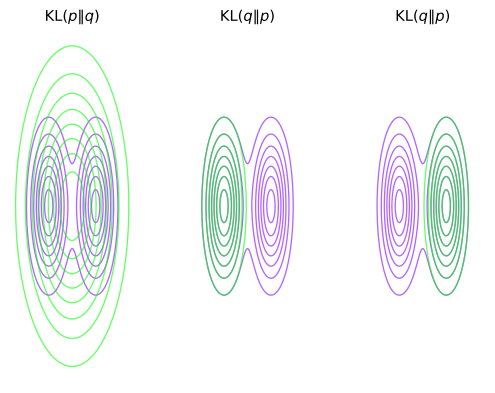
Thus, we have two possibilities.
- Variational Inference 1One important application and more recent implemenation of this is Variational Autoencoders!: Minimize the reverse KL divergence, $$ q^{\star}(\mathbf{z}) = \underset{q(\mathbf{z} \in \Omega}{\arg\min} \ \mathrm{KL}(q(\mathbf{z}) \mid \mid p(\mathbf{z} \mid \mathbf{x})) $$
- Expectation Propagation: Minimize the forward KL divergence, $$ q^{\star}(\mathbf{z}) = \underset{q(\mathbf{z} \in \Omega}{\arg\min} \ \mathrm{KL}(p(\mathbf{z} \mid \mathbf{x}) \mid \mid q(\mathbf{z})) $$
Intuition: Variational Inference
So, minimizing the reverse KL divergence corresponds to Variational Inference. However, this is still not tractable, as it requires knowledge of the true posterior $p(\mathbf{z} \mid \mathbf{x})$.
But, we can rewrite $\mathrm{KL}(q(\mathbf{z}) \mid \mid p(\mathbf{z} \mid \mathbf{x}))$ as, $$ \begin{align*} \mathrm{KL}(q(\mathbf{z}) \mid \mid p(\mathbf{z} \mid \mathbf{x})) & = - \int q(\mathbf{z}) \log \left(\frac{p(\mathbf{z} \mid \mathbf{x})}{q(\mathbf{z})}\right) \ d\mathbf{z} \newline & = - \int q(\mathbf{z}) \log \left(\frac{p(\mathbf{x}, \mathbf{z})}{q(\mathbf{z}) p(\mathbf{x})}\right) \ d\mathbf{z} \newline & = \log p(\mathbf{x}) - \underbrace{\int q(\mathbf{z}) \log \left(\frac{p(\mathbf{x}, \mathbf{z})}{q(\mathbf{z})}\right) \ d\mathbf{z}}_{\eqqcolon \mathcal{L}(q)} \newline & = \log p(\mathbf{x}) + \mathrm{KL}(q(\mathbf{z}) \mid \mid p(\mathbf{z} \mid \mathbf{x})) \newline \end{align*} $$ Further, it follows that, $$ \begin{align*} \log p(\mathbf{x}) & = \log \int p(\mathbf{x}, \mathbf{z}) \ d\mathbf{z} \newline & = \log \int q(\mathbf{z}) \frac{p(\mathbf{x}, \mathbf{z})}{q(\mathbf{z})} \ d\mathbf{z} \newline & = \log \left(\mathbb{E}_{q(\mathbf{z})} \left[\frac{p(\mathbf{x}, \mathbf{z})}{q(\mathbf{z})}\right]\right) \newline & \geq \mathbb{E}_{q(\mathbf{z})} \left[\log \left(\frac{p(\mathbf{x}, \mathbf{z})}{q(\mathbf{z})}\right)\right] \quad \text{(Jensen’s inequality)} \newline & = \int q(\mathbf{z}) \log \left(\frac{p(\mathbf{x}, \mathbf{z})}{q(\mathbf{z})}\right) \ d\mathbf{z} \newline & \triangleq \mathcal{L}(q) \end{align*} $$ $\mathcal{L}(q)$ is called the Evidence Lower Bound (ELBO), as it provides a lower bound on the log-evidence $\log p(\mathbf{x})$.
Thus, solving, $$ q^{\star}(\mathbf{z}) = \underset{q(\mathbf{z} \in \Omega}{\arg\min} \ \mathrm{KL}(q(\mathbf{z}) \mid \mid p(\mathbf{z} \mid \mathbf{x})) $$ is equivalent to solving, $$ q^{\star}(\mathbf{z}) = \underset{q(\mathbf{z} \in \Omega}{\arg\max} \ \mathcal{L}(q) \triangleq \int q(\mathbf{z}) \log \left(\frac{p(\mathbf{x}, \mathbf{z})}{q(\mathbf{z})}\right) \ d\mathbf{z} $$ which in general is (still) intractable!
But, we can choose a parametric distribution $q(\mathbf{z} \mid \boldsymbol{\omega})$ that is tractable, but rich enough to provide a good approximation of the true posterior. In this setting $\mathcal{L}(q)$ becomes a function of $\boldsymbol{\omega}$, i.e., $\mathcal{L}(\boldsymbol{\omega})$, thus we can exploit standard nonlinear optimization methods to find optimal parameters.
But we can also restrict $q(\mathbf{z})$ such that it factorizes as, $$ q(\mathbf{z}) = \prod_{i = 1}^M q_i(\mathbf{z}_i) $$ where $\mathbf{z}_1, \ldots, \mathbf{z}_M$ are disjoint partitions of $\mathbf{z}$.
Intuition: Mean-Field Variational Inference
This is called Mean-Field Variational Inference. In this case, we are solving the optimization problem, $$ \underset{q_1, \ldots, q_M}{\max} \ \mathcal{L}(q) $$ i.e., amongst all $q(\mathbf{z}) = \prod_{i = 1}^M q_i(\mathbf{z}_i)$, we want to find distribution with largest $\mathcal{L}(q)$.
Further, if you are familiar with optimization, we will optimize the ELBO using coordinate ascent, i.e., optimize one factor $q_j(\mathbf{z}_j)$ at a time, while keeping the others fixed.
Derivation: Solving Mean-Field Variational Inference with Coordinate Ascent
$$ q^{\star}_j(\mathbf{z}_j) = \underset{q(\mathbf{z} \in \Omega}{\arg\max} \ \mathcal{L}(q) \triangleq \int q(\mathbf{z}) \log \left(\frac{p(\mathbf{x}, \mathbf{z})}{q(\mathbf{z})}\right) \ d\mathbf{z} $$ with, $$ q(\mathbf{z}) = \prod_{i = 1}^M q_i(\mathbf{z}_i) $$
Singling out terms that involve $q_j(\mathbf{z}_j)$, we have, $$ \begin{align*} \mathcal{L}(q) & = \int \prod_i q_i \left(\log p(\mathbf{x}, \mathbf{z}) - \sum_k \log q_k(\mathbf{z}_k)\right) \ d\mathbf{z} \newline & = \left(\int \prod_i q_i \log p(\mathbf{x}, \mathbf{z}) \ d\mathbf{z}\right) - \left(\int \prod_i q_i \left(\sum_k \log q_k \right) \ d\mathbf{z}\right) \newline & = \left(\int \prod_i q_i \log p(\mathbf{x}, \mathbf{z}) \ d\mathbf{z}\right) - \left(\int q_j \log q_j \ d\mathbf{z}_j\right) - \left(\int \prod_i q_i \left(\sum_{k \neq j} \log q_k \right) \ d\mathbf{z}\right) \newline \end{align*} $$ Let’s focus term-by-term. First term, $$ \begin{align*} \int \prod_i q_i \log p(\mathbf{x}, \mathbf{z}) \ d\mathbf{z} & = \int q_j(\mathbf{z}_j) \left(\int \log p(\mathbf{x}, \mathbf{z}) \prod_{i \neq j} q_i(\mathbf{z}_i) \right) \ d\mathbf{z}_j \newline & = \int q_j \mathbb{E}_{\{\mathbf{z}_i\}_{i \neq j} \sim \prod_{i \neq j} q_i(\mathbf{z}_i)} [\log p(\mathbf{x}, \mathbf{z})] \ d\mathbf{z}_j \newline & = \int q_j \mathbb{E}_{i \neq j} [\log p(\mathbf{x}, \mathbf{z})] \ d\mathbf{z}_j \newline \end{align*} $$ For the second term, $$ \begin{align*} \int \prod_i q_i \log q_j \ d\mathbf{z} & = \int q_j \log q_j \prod_{i \neq j} q_i \ d\mathbf{z}_j \ d\mathbf{z}_{i \neq j} \newline & = \left(\int q_j \log q_j \ d\mathbf{z}_j\right) \left(\int \prod_{i \neq j} q_i \ d\mathbf{z}_{i \neq j}\right) \newline & = \int q_j \log q_j \ d\mathbf{z}_j \newline \end{align*} $$ Lastly, the third term, $$ \begin{align*} \int \prod_i q_i \left(\sum_{k \neq j} \log q_k \right) \ d\mathbf{z} & = \int q_j \prod_{i \neq j} q_i \left(\sum_{k \neq j} \log q_k \right) \ d\mathbf{z}_j \ d\mathbf{z}_{i \neq j} \newline & = \left(\int q_j \ d\mathbf{z}_j\right) \left(\int \prod_{i \neq j} q_i \left(\sum_{k \neq j} \log q_k \right) \ d\mathbf{z}_{i \neq j}\right) \newline & = \int \prod_{i \neq j} q_i \left(\sum_{k \neq j} \log q_k \right) \ d\mathbf{z}_{i \neq j} \newline \end{align*} $$ Note that here we are left with a constant (w.r.t. $q_j$)!
Thus, putting everything together, we have, $$ \begin{align*} \mathcal{L}(q) & = \int q_j \mathbb{E_{i \neq j} [\log p(\mathbf{x}, \mathbf{z})]} \ d\mathbf{z}_j - \int q_j \log q_j \ d\mathbf{z}_j + \text{const} \newline & = \int q_j \log \tilde{p}(\mathbf{x}, \mathbf{z}_j) \ d\mathbf{z}_j - \int q_j \log q_j \ d\mathbf{z}_j + \text{const} \newline & = \int q_j \log \left(\frac{\tilde{p}(\mathbf{x}, \mathbf{z}_j)}{q_j}\right) \ d\mathbf{z}_j + \text{const} \newline & = - \ \mathrm{KL}(q_j(\mathbf{z}_j) \mid \mid \tilde{p}(\mathbf{x}, \mathbf{z}_j)) + \text{const} \newline \end{align*} $$ where $\log \tilde{p}(\mathbf{x}, \mathbf{z}_j) \coloneqq \mathbb{E}_{i \neq j} [\log p(\mathbf{x}, \mathbf{z})]$.
Thus, if we go back to our optimization problem, $$ \begin{align*} q^{\star}_j(\mathbf{z}_j) & = \underset{q_j}{\arg\max} \ \mathcal{L}(q) \newline & = \underset{q_j}{\arg\max} \ - \ \mathrm{KL}(q_j(\mathbf{z}_j) \mid \mid \tilde{p}(\mathbf{x}, \mathbf{z}_j)) + \text{const} \newline & = \underset{q_j}{\arg\min} \ \mathrm{KL}(q_j(\mathbf{z}_j) \mid \mid \tilde{p}(\mathbf{x}, \mathbf{z}_j)) \newline & = \tilde{p}(\mathbf{x}, \mathbf{z}_j) \newline & = \exp \left(\mathbb{E}_{i \neq j} [\log p(\mathbf{x}, \mathbf{z})] + \text{const}\right) \newline \end{align*} $$ or, equivalently, $$ \log q^{\star}_j(\mathbf{z}_j) = \mathbb{E}_{i \neq j} [\log p(\mathbf{x}, \mathbf{z})] + \text{const} $$
Algorithm: Mean-Field Variational Inference with Coordinate Ascent
- Initialization: Set $\{q_i(\mathbf{z}_i)\}$.
- For $\ell = 1, \ldots, \ell_{\text{max}}$:
- Fix $\{q_i(\mathbf{z}_i)\}_{i \neq j}$ to their last estimated values $q_i^{\star}(\mathbf{z}_i)$.
- Update $q_j^{\star}(\mathbf{z}_j)$ as, $$ q_j^{\star}(\mathbf{z}_j) = \exp \left(\mathbb{E}_{i \neq j} [\log p(\mathbf{x}, \mathbf{z})] + \text{const}\right) $$
- Normalize $q_j^{\star}(\mathbf{z}_j)$.
- Repeat until ELBO $(\mathcal{L}(q))$ converges.
Variational Linear Regression
Example: Variational Linear Regression
We have previously used probabilistic models and joint distributions to solve the linear regression problem. Here, we will use Variational Inference to solve the same problem.
Recall: Predictive Distribution in Bayesian Linear Regression
Recall that the predictive distribution has the form, $$ p(y \mid \mathcal{D}, \mathbf{x}, \beta) = \int p(\mathbf{w} \mid \mathcal{D}, \beta) p(y \mid \mathbf{x}, \mathbf{w}, \beta) \ d\mathbf{w} $$ Thus, the goal to find an approximation of $p(\mathbf{w}, \alpha \mid \mathcal{D}, \beta) = p(\mathbf{w}, \alpha \mid \mathcal{D})$ is precisely the variational inference problem.
We will consider a posterior $p(\mathbf{w}, \alpha \mid \mathcal{D}, \beta) \approx q(\mathbf{w}, \alpha)$ that factorizes as, $$ q(\mathbf{w}, \alpha) = q(\mathbf{w}) q(\alpha) $$ with $q(\mathbf{w}, \alpha) \equiv p(\mathbf{w}, \alpha \mid \mathcal{D})$, $q(\mathbf{w}) \equiv p(\mathbf{w} \mid \mathcal{D})$, and $q(\alpha) \equiv p(\alpha \mid \mathcal{D})$. Thus, our goal is (again) to minimize ELBO.
Derivation: Variational Linear Regression
We need to iterate the equations, $$ \begin{align*} \log q^{\star}(\alpha) & = \mathbb{E}_{q(\mathbf{w})} [\log p(y_{\mathcal{D}}, \mathbf{w}, \alpha)] + \text{const} \newline \log q^{\star}(\mathbf{w}) & = \mathbb{E}_{q(\alpha)} [\log p(y_{\mathcal{D}}, \mathbf{w}, \alpha)] + \text{const} \newline \end{align*} $$ where $p(y_{\mathcal{D}}, \mathbf{w}, \alpha) = p(y_{\mathcal{D}} \mid \mathbf{w}) p(\mathbf{w} \mid \alpha) p(\alpha)$. Thus, $$ \begin{align*} \log q^{\star}(\alpha) & = \mathbb{E}_{q(\mathbf{w})} [\log p(y_{\mathcal{D}}, \mathbf{w}, \alpha)] + \text{const} \newline & = \mathbb{E}_{q(\mathbf{w})} [\log p(\mathbf{w} \mid \alpha) + \log p(\alpha)] + \text{const} \newline & = \log p(\alpha) + \mathbb{E}_{q(\mathbf{w})} [\log p(\mathbf{w} \mid \alpha)] + \text{const} \newline & = (a_0 - 1) \log \alpha - b_0 \alpha + \frac{M}{2} \log \alpha - \frac{\alpha}{2} \mathbb{E}_{q(\mathbf{w})} [\mathbf{w}^T \mathbf{w}] + \text{const} \newline \end{align*} $$ which is a Gamma distribution, $$ q^{\star}(\alpha) = \mathrm{Gam}(\alpha \mid a_N, b_N), \quad a_N = a_0 + \frac{M}{2}, \quad b_N = b_0 + \frac{1}{2} \mathbb{E}_{q(\mathbf{w})} [\mathbf{w}^T \mathbf{w}] $$ We can (easily) generalize this with, $$ \begin{align*} \log q^{\star}(\alpha) & = \mathbb{E}_{q(\mathbf{w})} [\log p(y_{\mathcal{D}}, \mathbf{w}, \alpha)] + \text{const} \newline & = \mathbb{E}_{q(\mathbf{w})} [\log p(\mathbf{w} \mid \alpha) + \log p(\alpha)] + \text{const} \newline & = \log p(\alpha) + \mathbb{E}_{q(\mathbf{w})} [\log p(\mathbf{w} \mid \alpha)] + \text{const} \newline & = - \frac{\beta}{2} \sum_{i = 1}^N (y_i - \mathbf{w}^T \boldsymbol{\phi}(\mathbf{x}_i))^2 - \frac{1}{2} \mathbb{E}_{q(\alpha)} [\alpha] \mathbf{w}^T \mathbf{w} + \text{const} \newline & = -\frac{1}{2} \mathbf{w}^T \left(\mathbb{E}_{q(\alpha)} [\alpha] \mathbf{I} + \beta \boldsymbol{\Phi}^T \boldsymbol{\Phi}\right) \mathbf{w} + \beta \mathbf{w}^T \boldsymbol{\Phi}^T \mathbf{y}_{\mathcal{D}} + \text{const} \newline \end{align*} $$ which is a Gaussian distribution, $$ q^{\star}(\mathbf{w}) = \mathcal{N}(\mathbf{w} \mid \mathbf{m}_N, \mathbf{S}_N), \quad \mathbf{S}_N = \left(\mathbb{E}_{q(\alpha)} [\alpha] \mathbf{I} + \beta \boldsymbol{\Phi}^T \boldsymbol{\Phi}\right)^{-1}, \quad \mathbf{m}_N = \beta \mathbf{S}_N \boldsymbol{\Phi}^T \mathbf{y}_{\mathcal{D}} $$
Expectation Propagation
Intuition: Expectation Propagation
Consider, $$ p(\mathcal{D}, \boldsymbol{\theta}) \coloneqq \prod_i^I f_i(\boldsymbol{\theta}) $$ where $f_i(\boldsymbol{\theta})$ are factors (e.g., likelihoods, priors, etc.), our goal is to evaluate $p(\boldsymbol{\theta} \mid \mathcal{D})$, $$ p(\boldsymbol{\theta} \mid \mathcal{D}) \coloneqq \frac{1}{p(\mathcal{D})} \prod_i^I f_i(\boldsymbol{\theta}) $$ We can approximate $p(\boldsymbol{\theta} \mid \mathcal{D})$ with a tractable distribution $q(\boldsymbol{\theta}) \in \Omega$, $$ q(\boldsymbol{\theta}) \coloneqq \frac{1}{Z} \prod_i^I q_i(\boldsymbol{\theta}) $$ Often assumed that factors come from the exponential family, i.e., $$ q(\boldsymbol{\theta}) = \frac{1}{Z} \prod_i^I \mathcal{N}(\boldsymbol{\theta} \mid \boldsymbol{\mu}_i, \boldsymbol{\Sigma}_i) $$ Thus, we want to find $q(\boldsymbol{\theta})$ that minimizes the forward KL divergence, $$ q^{\star}(\boldsymbol{\theta}) = \underset{q(\boldsymbol{\theta}) \in \Omega}{\arg\min} \ \mathrm{KL}(p(\boldsymbol{\theta} \mid \mathcal{D}) \mid \mid q(\boldsymbol{\theta})) $$ However, this is still intractable, as it requires knowledge of the true posterior $p(\boldsymbol{\theta} \mid \mathcal{D})$.
The idea is instead to optimize each factor in turn (keeping others constant).
Algorithm: Expectation Propagation
-
Initial factors $q_i(\boldsymbol{\theta})$.
-
Until convergence, cycle through factors $q_j(\boldsymbol{\theta})$ and optimize as, $$ q_j^{\text{new}}(\boldsymbol{\theta}) = \underset{q_j(\boldsymbol{\theta}) \in \Omega}{\arg\min} \ \mathrm{KL}\left[\frac{1}{p(\mathcal{D})} f_j(\boldsymbol{\theta}) \prod_{i \neq j} q_i(\boldsymbol{\theta})^{\text{old}}(\boldsymbol{\theta}) \mid \mid \frac{1}{Z} q_j(\boldsymbol{\theta}) \prod_{i \neq j} q_i^{\text{old}}(\boldsymbol{\theta})\right] $$