Research

I am primarily interested in (multi-agent) sequential decision-making and reinforcement learning. I want to understand how systems can learn from experience, plan ahead, and reason about the consequences of actions in realistic settings with partial observability, uncertainty, and risk constraints.

Selected Projects

A Deeper Understanding of Active Feature Acquisition

My MSc thesis studied active feature acquisition as sequential decision-making under costly and missing information. We developed AFABench as a modular evaluation framework and extended the AFA POMDP to missing data during training, showing how missing data can distort both beliefs and the acquisition routes a policy learns to value.
AFABench: A Generic Framework for Benchmarking Active Feature Acquisition

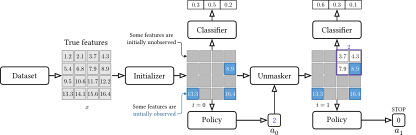
AFABench is a generic framework for benchmarking active feature acquisition in classification. It standardizes episode interfaces, budget protocols, datasets, methods, and diagnostics so myopic, subset-based, and reinforcement-learning policies can be compared under the same cost-performance trade-off.

Accepted to KDD 2026
Datasets & Benchmarks Track. 513 complete submissions, with an overall acceptance rate of about 29%.
An AFABench episode where a policy sequentially acquires features before prediction.
AFABench evaluation episode.

Scaling Generative Models for Molecular Dynamics

At AIMLeNS, I worked on scaling generative models for molecular dynamics. This project shaped how I think about generative modeling in scientific settings, where useful models must respect geometry, sampling behavior, robustness, and the physical structure of the system being studied.

Causality-Δ: Jacobian-Based Dependency Analysis in Flow Matching Models

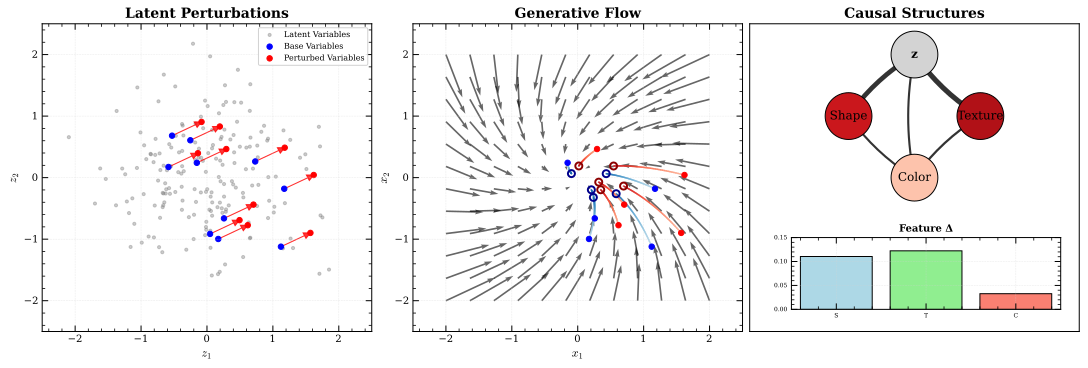
Causality-Δ studies how local derivative information can expose dependency structure in flow-matching generative models. We use Jacobian-vector products to trace how latent perturbations propagate through learned dynamics, giving a practical way to inspect model geometry while keeping a clear boundary between local dependence and causal intervention.

Overview of Jacobian-based dependency analysis in flow matching models.
Jacobian-based dependency analysis in flow matching.

ClaudesLens: Uncertainty Quantification in Computer Vision Models

My BSc thesis studied uncertainty quantification in computer vision models using Shannon entropy as a practical measure of predictive uncertainty. We focused on how confidence changes under perturbations and when a model output should be treated with caution rather than accepted as a reliable prediction.

ClaudesLens project logo.