Overview

Part 2 - Power & Energy

In this part we’ll cover and properly define a very misunderstood concept in physics, power and energy.

Let’s start with defining power properly.

Power

Power can be defined as:

Definition 1 (Power)

Rate of energy transferred, or work done, per unit of time.

In electrical circuits, we can define power, PP, as,

P=V⋅I.P = V \cdot I.

We measure power in watts, which we can define as,

1 W=1 Js=1 N⋅ms=1 kg⋅m2⋅s−3.1\,\mathrm{W} = 1\,\frac{\mathrm{J}}{\mathrm{s}} = 1\,\frac{\mathrm{N \cdot m}}{\mathrm{s}} = 1\,\mathrm{kg \cdot m^2 \cdot s^{-3}}.

We’ll mainly only encounter the P=V⋅IP = V \cdot I variant, however.

Using Ohm’s law that we learned from Part 1 we find that,

P=V⋅I=V2R=I2R.P = V \cdot I = \frac{V^2}{R} = I^2 R.

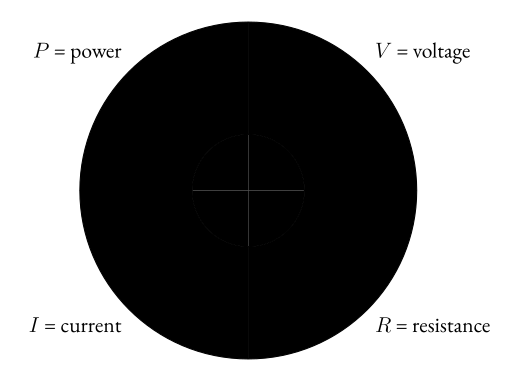
We can throw around this equation as much as we want and need, here’s a picture that illustrates all the possible combinations:

The possible combinations of power, voltage, current and resistance.
Figure 1: The possible combinations of power, voltage, current and resistance.

Energy

Energy can be defined as:

Definition 2 (Energy)

The capacity to do work in a given time.

Or in math terms,

W=∫t1t2P(t) dt.W = \int_{t_1}^{t_2} P(t) \, dt.

So, therefore:

  • Power is Energy per unit of time.
  • Energy is Power over time.

Positive and negative power

One small note here is that, power can end up being negative, which can be confusing at first.

We view this as we’re supplying power into a system. Therefore, positive power is consuming the power.

So:

  • Positive: Power being consumed
  • Negative: Power being supplied

Equivalent resistance

As we saw in the first part, we covered that in series circuits, the current needs to be the same. While in a parallel circuit, the voltage will need to be the same. We can use this to our advantage and find how we can simplify our circuits when we have a lot of resistors.

Equivalent resistance in series circuits

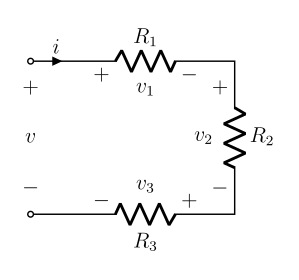
If we have a simple circuit of three resistors like this:

Three resistors in series.
Figure 2: Three resistors in series.

Using Ohm’s law and the fact that we know this is a series circuit we can find,
V=v1+v2+v3=I⋅R1+I⋅R2+I⋅R3=(R1+R2+R3)⋅I=Req⋅I,\begin{align*} V & = v_1 + v_2 + v_3 \newline & = I \cdot R_1 + I \cdot R_2 + I \cdot R_3 \newline & = (R_1 + R_2 + R_3) \cdot I \newline & = R_{eq} \cdot I, \end{align*}

where ReqR_{eq} is,

Req=R1+R2+R3.R_{eq} = R_1 + R_2 + R_3.

Or, more generally, if we have NN resistors in series, we can find the equivalent resistance as,

Req=R1+R2+…+RN.R_{eq} = R_1 + R_2 + \ldots + R_N.

Equivalent resistance in parallel circuits

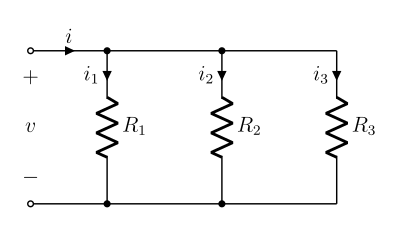
Now, if we instead have three parallel resistors like:

Three resistors in parallel.
Figure 3: Three resistors in parallel.

Again, using Ohm’s law and the fact that this is a parallel circuit we can find,

I=I1+I2+I3=VR1+VR2+VR3=(1R1+1R2+1R3)⋅V.\begin{align*} I & = I_1 + I_2 + I_3 \newline & = \frac{V}{R_1} + \frac{V}{R_2} + \frac{V}{R_3} \newline & = \left(\frac{1}{R_1} + \frac{1}{R_2} + \frac{1}{R_3}\right) \cdot V. \end{align*}

Which means our ReqR_{eq} is,

Req=11R1+1R2+1R3.R_{eq} = \frac{1}{\frac{1}{R_1} + \frac{1}{R_2} + \frac{1}{R_3}}.

Another way of writing this is,

Req=R1R2R3R1R2+R2R3+R1R3.R_{eq} = \frac{R_1 R_2 R_3}{R_1 R_2 + R_2 R_3 + R_1 R_3}.

Current and Voltage dividers

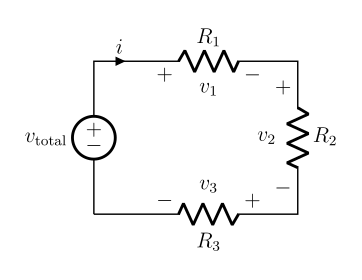
If we have this circuit:

Voltage divider.
Figure 4: Voltage divider.
Req=R1+R2+R3,I=VtotalReq.\begin{align*} R_{eq} & = R_1 + R_2 + R_3, \newline I & = \frac{V_{\text{total}}}{R_{eq}}. \end{align*}

We can find equations for the relative voltages,

V1=I⋅R1=Vtotal⋅R1R1+R2+R3,V2=I⋅R2=Vtotal⋅R2R1+R2+R3,V3=I⋅R3=Vtotal⋅R3R1+R2+R3.\begin{align*} V_1 & = I \cdot R_1 = V_{\text{total}} \cdot \frac{R_1}{R_1 + R_2 + R_3}, \newline V_2 & = I \cdot R_2 = V_{\text{total}} \cdot \frac{R_2}{R_1 + R_2 + R_3}, \newline V_3 & = I \cdot R_3 = V_{\text{total}} \cdot \frac{R_3}{R_1 + R_2 + R_3}. \end{align*}

This is what we call a voltage divider.

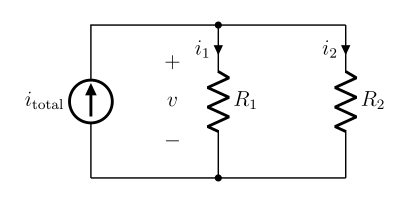
If we instead have this circuit:

Current divider.
Figure 5: Current divider.
Req=R1R2R1+R2,V=ItotalReq.\begin{align*} R_{eq} & = \frac{R_1 R_2}{R_1 + R_2}, \newline V & = I_{\text{total}} R_{eq}. \end{align*}

We can find equations for the relative currents,

I1=VR1=ItotalR2R1+R2,I2=VR2=ItotalR1R1+R2.\begin{align*} I_1 & = \frac{V}{R_1} = I_{\text{total}} \frac{R_2}{R_1 + R_2}, \newline I_2 & = \frac{V}{R_2} = I_{\text{total}} \frac{R_1}{R_1 + R_2}. \end{align*}

Search

Essays, lecture notes, and research

Type to search the site.