Why do we learn both forms and how to convert them? Because, if we want to perform multiplication or division - it’s much easier done in Polar form.
If we want to perform addition or subtraction, it’s easier done in rectangular form.
Multiplication,
a=(b∠c∘)⋅(d∠e∘)=bd∠(c∘+e∘).
Division,
a=d∠e∘b∠c∘=db∠(c∘−e∘).
Phasor relations
Now that we’ve defined phasors, let’s look at the relationship between different concepts we have encountered.
Resistance
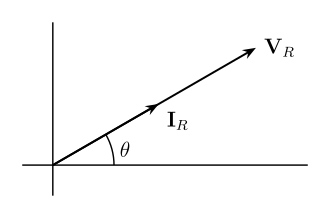
As we know from Ohm’s law: V=RI. If our V and I both are phasors - it means that they are in parallel:
Figure 2: Voltage and current phasors of a resistor.
Inductor
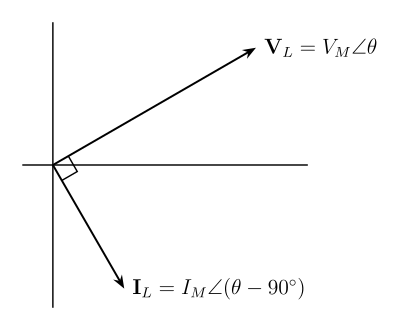
As we know, V=LdtdI. Now, if both our V and I are phasors, it means that taking the derivative of I will make it either sine or cosine.
This means in the end that V and I will be 90∘ apart!
Figure 3: Voltage and current phasors of an inductor.
As you may or may not know, but multiplying something with the imaginary unit rotates it by 90∘.
This means that,
V=jωLI.
Capacitor
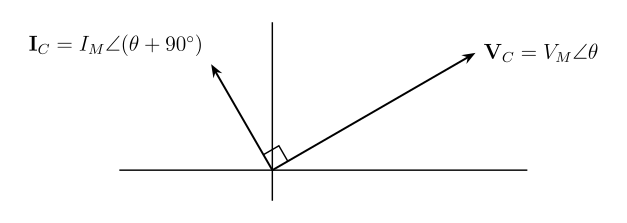
We know that, I=CdtdV. The same logic applies here, since taking the derivative of a sinusoidal function will shift it by 90∘ this means that,
I=jωCV.Figure 4: Voltage and current phasors of a capacitor.
Summary
This means that we now have two different ways to calculate these equations - in the time domain or in the frequency domain:
Time domain,
VVV=RI,=LdtdI,=C1∫Idt.
Frequency domain,
VVV=RI,=jωLI,=jωC1I.
Impedance
The definition of impedance can be quite dense and technical - but in this series we’ll settle with the definition that,
Definition 3 (Impedance)Z=IV
This means that,
ZRZLZC=R,=jωL,=jωC1.
Impedance is therefore a complex number, but in the unit Ohm!
We call the imaginary component of impedance reactance.
A purely resistive impedance is equal to the resistance. A purely reactive impedance has no real component.
Impedances in series and parallel follow the same rules as resistors! So we can combine and simplify our circuits even more now!
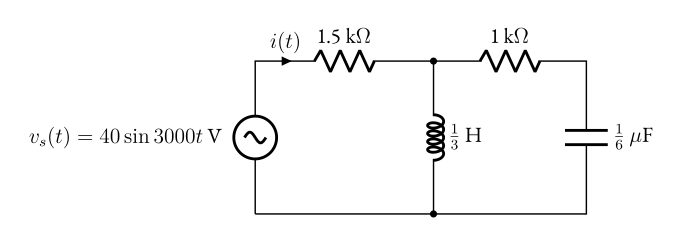
But the most important thing here is that, we can, just from impedance, understand what dominates in a circuit:
Figure 5: Example circuit.Zeq=1.5+j+1−2j(j)(1−2j)=1.5+1−j2+j=1.5+(1−j)(1+j)(2+j)(1+j)=1.5+21+j3=2.5∠36.87∘kΩ.
From this, we can see that, since we have a positive impedance angle, means that it’s mostly inductive than anything else. This tells us a lot about the circuit.
Since inductors resist change in the current, it will ultimately mean that the current is late, or lags behind the voltage!
Which is exactly what we’ll see if we calculate I(t):
I=ZeqV=2.5∠36.87∘40∠−90∘=16∠−126.9∘mA.
Which means,
I(t)=16cos(3000t−126.9∘)mA.
Just as we predicted, the current lags behind by a lot!
As we can see, our new tools and knowledge about how we can use complex numbers are quite powerful!