Part 6 - Work, Voltage and Capacitance

In this part we’ll work in electrical fields, the connection between electrical fields and voltages as well as how we can use electrical fields with capacitors.

Work

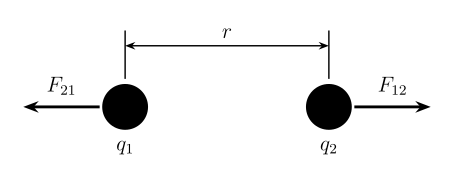
We’ve briefly went over work before in this series - but let’s consider the work required to move charges apart from eachother.

For example:

W=F drW = F \cdot\ d\mathbf{\vec{r}} \newline F12=ke q1q2r2r12\mathbf{\vec{F_{12}}} = k_{e}\ \dfrac{q_1 q_2}{r^2} \mathbf{\vec{r_{12}}} W=RF dr=keq1q2Rdrr2=keq1q2 1rR=keq1q2R\begin{align*} W & = \int_{R}^{\infty} \mathbf{\vec{F}} \cdot\ d\mathbf{\vec{r}} \newline & = -k_e q_1 q_2 \int_{R}^{\infty} \dfrac{d\mathbf{\vec{r}}}{r^2} \newline & = k_e q_1 q_2 \cdot\ \dfrac{-1}{r} \Big|_R^{\infty} \newline & = \boxed{\dfrac{k_e q_1 q_2}{R}} \end{align*}

Work in an electrical field

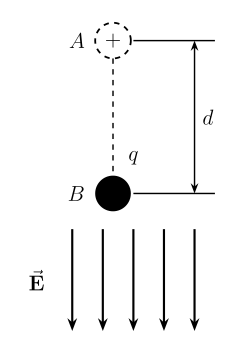
Now, if we consider a charge moving inside an electrical field:

Let’s calculate the work to move from A to B.

W=F drW = \mathbf{\vec{F}} \cdot\ d\mathbf{\vec{r}} FE=qE\mathbf{\vec{F}_E} = q \mathbf{\vec{E}} W=ABF dr=ABqE dr=qE0ABdr=qE0d\begin{align*} W & = - \int_A^B \mathbf{\vec{F}} \cdot\ d\mathbf{\vec{r}} \newline & = - \int_A^B q\mathbf{\vec{E}} \cdot\ d\mathbf{\vec{r}} \newline & = -qE_0 \int_A^B d\mathbf{\vec{r}} \newline & = -qE_0d \end{align*}

Note, in the case when we move perpendicular to the field, the work is 0.

Another way we can write work is:

W=ΔU=ABF dr\begin{align*} W & = \Delta U \newline & = - \int_A^B \mathbf{\vec{F}} \cdot\ d\mathbf{\vec{r}} \end{align*}

This means that the potential is proportional to the charge:

FE=qE\mathbf{\vec{F}_E} = q\mathbf{\vec{E}}

If we normalize the work with the charge we’ll see a very interesting result:

Wq=ABE dr\begin{align*} \dfrac{W}{q} & = - \int_A^B \mathbf{\vec{E}} \cdot\ d\mathbf{\vec{r}} \end{align*}

If we just interpret this integral, we move a charged particle a distance.

Let’s go back to our definition of voltage from the first part - this is precisely the difference in voltage!

[ΔV]=JoulesCoulumb[\Delta V] = \dfrac{Joules}{Coulumb}

Just as Kirchoff’s voltage law tells us that, within a closed loop, the sum of the voltages are 0.

This means that the work done within a closed path:

W=F dr=0W = - \oint \mathbf{\vec{F}} \cdot\ d\mathbf{\vec{r}} = 0

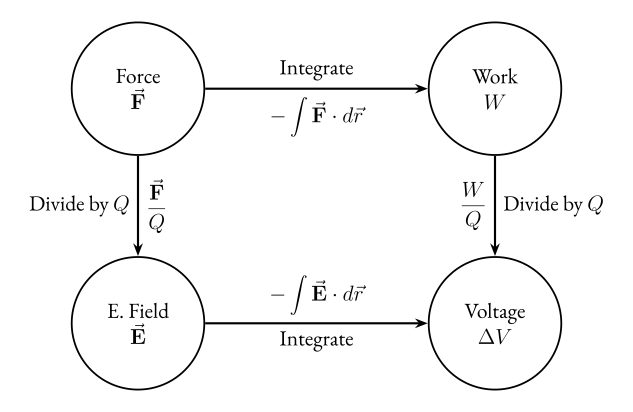
With all these new formulas, here is a little cheat sheet so that we remember:

Electrical fields

If we work backwards from a known voltage - we can find the electrical field!

ΔV=ABE dr\Delta V = - \int_A^B \mathbf{\vec{E}} \cdot\ d\mathbf{\vec{r}} dV=EdrdV = -\mathbf{\vec{E}} \cdot d\mathbf{\vec{r}} E=dVdr\mathbf{\vec{E}} = - \dfrac{dV}{d\mathbf{\vec{r}}}

We can define this as the gradient of the voltage:

E=V\mathbf{\vec{E}} = - \nabla V

Equipotential curves

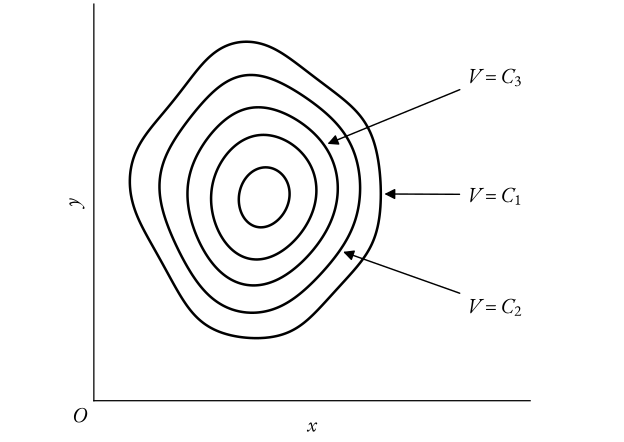
As we just discovered - the electrical field is equal to the gradient of the voltage. Equipotential curves are way of visualizing the electric potential in a region of space. They are just like geographical maps!

Now the interesting part is that these curves are always perpendicular to the electrical field lines!

Capacitance

Capacitance is the ability for an electrical potential to hold a charge

We define capacitance as:

C=qΔVC = \dfrac{q}{|\Delta V|}

Capacitors

Capacitors are two isolated plates with equal and opposite charges: ±q\pm q

When they are charged, they create a voltage diffrence between the plates, naturally.

How can we calculate this voltage?

Assume we have a surface area of AA, a surface charge density of σ\sigma.

We can define charge as:

q=σAq = \sigma A

Let’s recall our Gaussian pillbox:

Φ=E dA=qencε0\begin{align*} \Phi & = \oiint \mathbf{\vec{E}} \cdot\ d\mathbf{\vec{A}} \newline & = \dfrac{q_{enc}}{\varepsilon_0} \end{align*}

For a given area, say, A1A_1, we can write:

EA1=qε0=σA1ε0\begin{align*} EA_1 & = \dfrac{q}{\varepsilon_0} \newline & = \dfrac{\sigma A_1}{\varepsilon_0} \end{align*}

Which means:

E=σε0=qε0A\begin{align*} E & = \dfrac{\sigma}{\varepsilon_0} \newline & = \boxed{\dfrac{q}{\varepsilon_0 A}} \end{align*}

Let’s apply this on capacitors:

ΔV=+E dr=Ed\Delta V = - \int_+^- \mathbf{\vec{E}} \cdot\ d\mathbf{\vec{r}} = -Ed Ed=qε0AdEd = \dfrac{q}{\varepsilon_0 A} d C=qΔV=qqε0Ad=ε0Ad\begin{align*} C & = \dfrac{q}{|\Delta V|} \newline & = \dfrac{q}{\dfrac{q}{\varepsilon_0 A} d} \newline & = \boxed{\varepsilon_0 \dfrac{A}{d}} \end{align*}

This means, the capacitance is solely dependent of the geometry of the capacitor!

Energy stored in capacitors

Recall from earlier that we deduced that:

Wq=ABE ds=ΔV\dfrac{W}{q} = - \int_A^B \mathbf{\vec{E}} \cdot\ d\mathbf{\vec{s}} = \Delta V

This means:

dW=dqΔV=dqqCdW = dq \Delta V = dq \dfrac{q}{C} W=dW=1C0Qq dq=1C Q22W = \int dW = \dfrac{1}{C} \int_0^Q q\ dq = \boxed{\dfrac{1}{C}\ \dfrac{Q^2}{2}}

How is the (potential) energy stored?

U=1C Q22=12QΔV=12CΔV2U = \dfrac{1}{C}\ \dfrac{Q^2}{2} = \dfrac{1}{2} Q |\Delta V| = \dfrac{1}{2} C |\Delta V|^2 \newline 12CΔV2=12 ε0Ad(Ed)2=12ε0E2Ad=u ×volume\dfrac{1}{2} C |\Delta V|^2 = \dfrac{1}{2}\ \dfrac{\varepsilon_0 A}{d} (Ed)^2 = \dfrac{1}{2} \varepsilon_0 E^2 Ad = u\ \times volume

Where, uu, is called the electrical field density:

u=ε0E22u = \dfrac{\varepsilon_0 E^2}{2}